

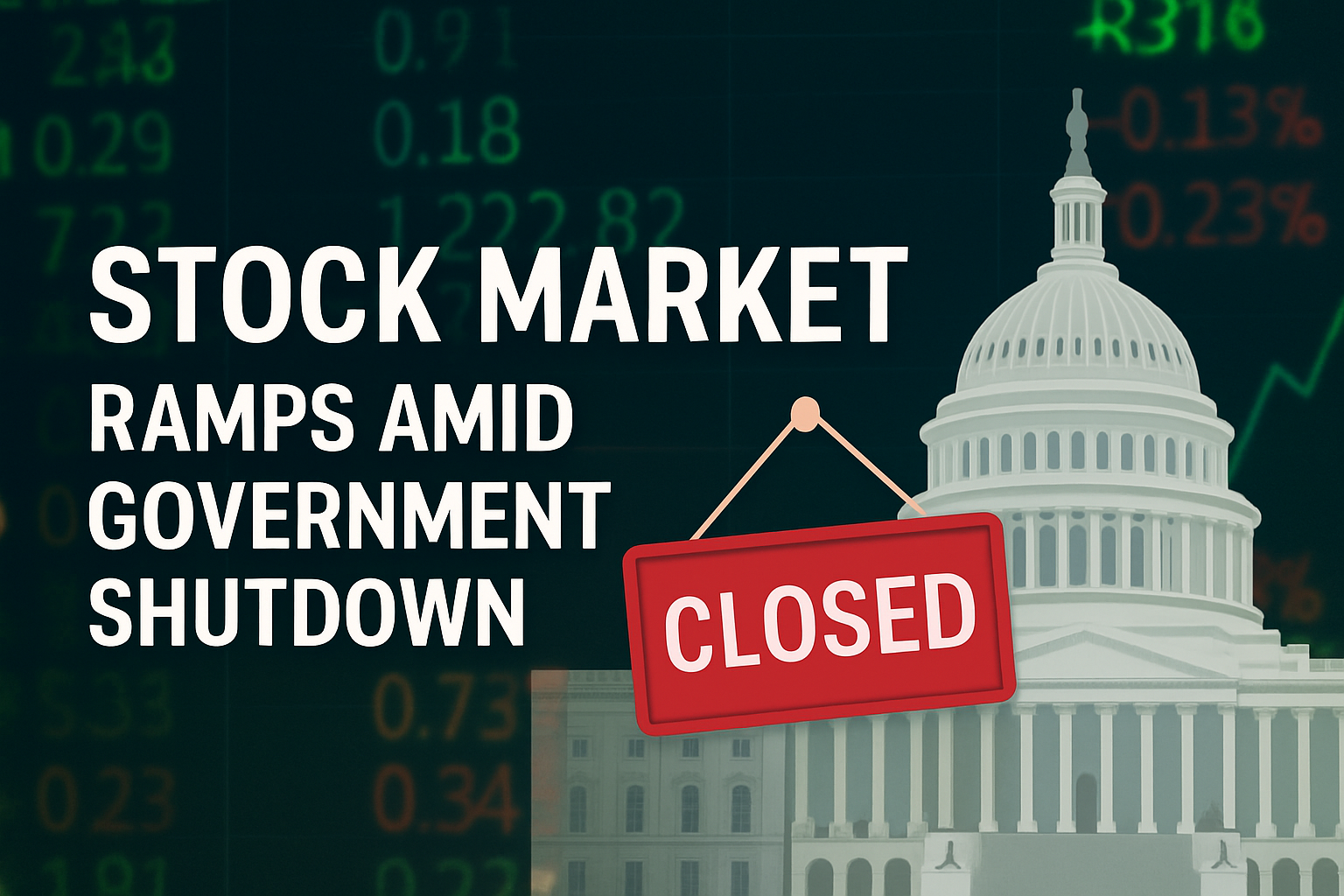

The U.S. stock market began the final week of September 2025 on a cautious yet optimistic note. Despite heightened political uncertainty and a looming government shutdown, both the S&P 500 and the Nasdaq Composite extended their gains, signaling investor resilience in the face of potential economic turbulence.
The question now is: how long can this optimism last, and what does it mean for traders, long-term investors, and everyday Americans?
Market Recap: Green Shoots Amid Uncertainty
On Monday morning, the S&P 500 climbed about 0.4% and the Nasdaq nearly 0.9%, while the Dow Jones Industrial Average slipped slightly into the red. Tech stocks led the way, boosted by heavyweights like Nvidia, which is once again flirting with record highs despite ongoing geopolitical headwinds in its China business.
This positive momentum comes after a volatile prior week, when rising bond yields, mixed labor data, and fresh tariff threats rattled markets. Yet September is set to close with all three major indexes in the green:
- S&P 500: +2.8% month-to-date
- Nasdaq Composite: +2.9%
- Dow Jones: +1.5%
The rally underscores investors’ ability to shrug off noise — at least temporarily — and focus on growth sectors like technology and consumer spending.
The Government Shutdown Threat: Why This Time Is Different
Markets are now bracing for the potential of a federal government shutdown if lawmakers fail to reach a funding deal by midweek. According to betting markets like Polymarket, the odds of a shutdown exceed 70%.
Unlike previous shutdowns that investors often dismissed as political theater, this one carries higher stakes:
- Data Delays: Key economic releases — including Friday’s monthly jobs report — could be postponed. Without updated labor market data, the Federal Reserve would be flying blind ahead of its next policy meeting.
- Policy Uncertainty: President Trump has hinted at using the shutdown as leverage, even suggesting mass federal layoffs in “non-priority” programs. Such moves could reshape the labor market and drag down consumer spending.
- Investor Confidence: A prolonged shutdown risks shaking the fragile confidence underpinning today’s equity rally, particularly as earnings season approaches.
In short, this shutdown isn’t just about politics — it could directly impact Wall Street’s most important input: reliable economic data.
The Fed, Jobs, and the Path of Interest Rates
For investors, the September jobs report is the crown jewel of this week. Forecasts call for 43,000 new nonfarm payrolls and an unemployment rate steady at 4.3%.
Why does this matter? Because the Fed’s path toward interest rate cuts depends heavily on whether the labor market shows signs of weakness.
- Weaker jobs data ? More likely the Fed cuts rates aggressively ? Markets cheer.
- Stronger jobs data ? Fed may hold back on cuts ? Potential stock market pullback.
But if the shutdown delays this data, the Fed is left with guesswork, and markets are left with more volatility.
Company-Specific Movers: Winners and Losers
Several companies stood out on Monday’s trading session:
- Nvidia (NVDA): Rose over 3%, nearing record highs despite competition from Huawei’s AI chips in China. Demand for Nvidia’s GPUs remains “off the charts,” according to Bernstein analysts.
- Intel (INTC): Pulled back after a monster rally last week, down over 3%. Analysts caution that Intel’s turnaround will take years despite government and private investment.
- Carnival (CCL): Reported better-than-expected earnings and raised its profit forecast, giving cruise stocks a much-needed boost.
- Electronic Arts (EA): Surged nearly 5% after announcing it would be acquired in a record-breaking $55 billion leveraged buyout by a consortium including Saudi Arabia’s Public Investment Fund.
- MoonLake Immunotherapeutics (MLTX): Suffered a devastating collapse, plunging nearly 90% after trial data showed its skin disease drug underperformed rivals.
These moves reflect the current “barbell” nature of the market — investors flocking to proven tech leaders while punishing underperforming smaller firms.
Commodities & Global Markets
The uncertainty in Washington also rippled across commodities:
- Gold surged past $3,800/oz, a new record high, as investors sought safety from a weaker U.S. dollar and political instability.
- Oil prices fell, with Brent dropping below $70 as OPEC+ considers raising production. Analysts warn of a potential glut in 2026.
These contrasting moves highlight a classic divergence: energy markets pricing in oversupply, while precious metals thrive on uncertainty.
Cannabis, Tariffs, and the “New Normal”
Outside of the headlines, two other themes are worth watching:
- Cannabis Stocks: Shares of Canopy Growth, Tilray, and Cronos jumped double digits after Trump hinted at supporting CBD in senior healthcare. While not outright legalization, this could represent a regulatory shift that re-energizes the struggling cannabis sector.
- Tariffs & Trade: Trump’s new tariff announcements — extending duties to movies and furniture — reinforce a trend of escalating protectionism. Investors should monitor how these policies ripple through inflation and corporate earnings.
- Valuations: Wall Street strategists, including Bank of America’s Savita Subramanian, suggest today’s elevated market valuations may represent a “new normal.” With AI-driven growth and strong earnings, comparisons to the dot-com bubble may be overstated — though risks remain.
What Investors Should Watch Next
As September closes, the stage is set for a potentially volatile October. Here are the key takeaways:
- Government Shutdown: A deal — or lack thereof — could swing markets sharply.
- Jobs Report: Still the most important economic release of the month (if it happens).
- Earnings Season: Beginning mid-October, starting with major banks.
- Fed Meeting: Investors want clarity on the pace of rate cuts.
- Global Risks: From OPEC+ decisions to China’s tech ambitions, geopolitics remain a wildcard.
Final Thoughts: Navigating a Market in Flux
The U.S. stock market is balancing on a knife’s edge. On one side lies optimism — resilient tech, strong corporate earnings, and the promise of Fed rate cuts. On the other side sits political dysfunction, economic uncertainty, and cracks in global growth.
For investors, the strategy here is less about panic and more about preparation:
- Diversify across sectors, especially those less sensitive to shutdown risk.
- Hold some defensive assets like gold or dividend stocks.
- Stay nimble — October could bring rapid swings.
Markets may be climbing today, but with Washington gridlock intensifying and economic data at risk of going dark, the next few weeks will test just how much uncertainty investors can stomach.
Frequently Asked Questions (FAQ)
1. Why are stocks rising if there’s a risk of a government shutdown?
Markets often look past short-term political drama and focus on broader economic growth and corporate earnings. Tech stocks in particular are driving gains due to strong demand for AI and innovation. However, if the shutdown drags on and delays key data, investor sentiment could quickly shift.
2. How would a government shutdown affect the economy?
A shutdown would pause many federal services, delay paychecks for government workers, and suspend the release of critical economic data like the monthly jobs report. While short shutdowns usually have limited economic impact, longer ones could dent consumer spending and slow GDP growth.
3. Why is the September jobs report so important for investors?
The Federal Reserve uses jobs data to guide interest rate policy. A weaker labor market increases the likelihood of rate cuts, which usually supports stocks. A strong report could delay rate cuts, creating short-term pressure on equities.
4. Which sectors benefit during times of uncertainty?
Defensive sectors like healthcare, utilities, and consumer staples often perform better during periods of political or economic instability. Gold and other safe-haven assets also tend to rise when markets face uncertainty.
5. Why is gold hitting record highs?
Gold is viewed as a hedge against uncertainty and inflation. With the U.S. dollar weakening and political risks like a shutdown looming, investors are pouring into gold as a store of value.
6. What stocks are investors watching right now?
- Nvidia (NVDA): Riding AI demand to near record highs.
- Intel (INTC): Pulling back after a strong rally but still key to semiconductor recovery.
- Carnival (CCL): Surged on upbeat earnings guidance.
- Electronic Arts (EA): Spiked on news of a massive leveraged buyout.
- MoonLake Immunotherapeutics (MLTX): Collapsed after poor drug trial results.
7. How do tariffs affect the stock market?
Tariffs raise costs for businesses and consumers, potentially fueling inflation. While some domestic industries benefit, global supply chains often face disruptions. This uncertainty can weigh on corporate earnings and investor sentiment.
8. Is now a good time to invest in cannabis stocks?
Cannabis stocks rallied on hints of regulatory support from the White House, but the sector remains volatile. Long-term growth may come from legalization trends, but short-term risks are still high.
9. What should investors do if volatility increases in October?
- Diversify across asset classes.
- Hold some safe-haven assets like gold or cash.
- Focus on high-quality companies with strong balance sheets.
- Avoid emotional trading — volatility can create opportunities as well as risks.
10. What’s the outlook for the stock market going into October?
October is historically one of the most volatile months for stocks. With earnings season approaching, a possible shutdown, and Fed uncertainty, markets could swing sharply. Long-term investors should focus on fundamentals rather than daily headlines.